

Who it's for
When to use this service
Insurers needing a fast, independent second opinion
Brokers managing a claim on behalf of a client
Bodyshops needing an estimate validated
Any claim where the vehicle does not need physical inspection
What's included
Every desktop assessment covers
- Line-by-line estimate validation
- Repair vs total-loss decision
- Pre-accident valuation (PAV)
- Salvage category assessment
- 24-hour desktop report option
- Structured for your claims file
How it works
Three steps, no chasing
- 01Send the fileClaim reference, vehicle details and photos, online or by email. Takes 60 seconds.
- 02We assessDesktop review against Audatex data, checked line by line.
- 03Report deliveredA clear, defensible report, with a 24-hour option available.

What a desktop assessment involves
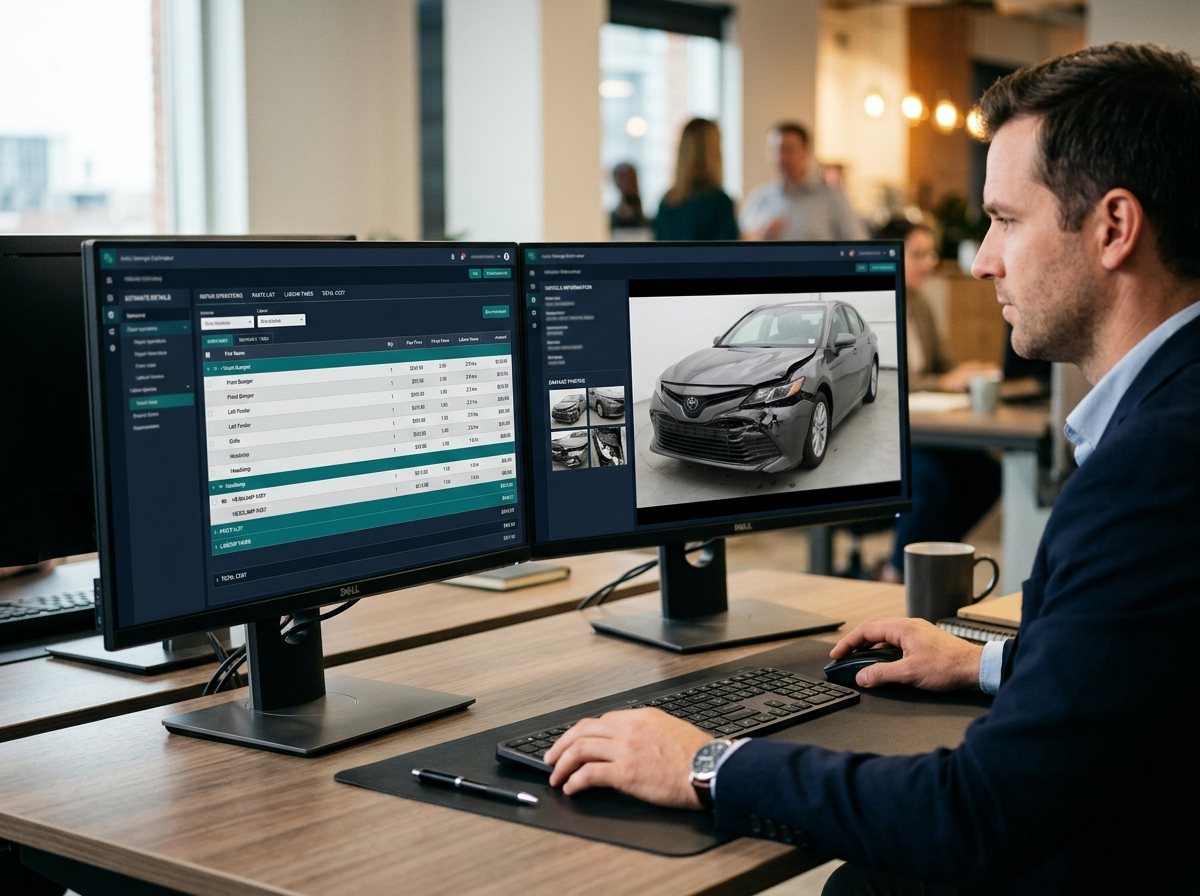
A desktop assessment starts with the evidence. We take the photographs of the damage, the repairer's estimate and the vehicle details, and rebuild the job from the ground up rather than simply reading down the estimate and agreeing with it. The vehicle is identified precisely, because parts prices and labour times differ between trim levels and build dates on what looks like the same model.
Every line is then validated against Audatex data for that specific vehicle. Part prices are checked against current supply, labour times are checked against the published times for the operation, and the repair method is checked against what the damage actually supports. This is where most of the value sits: an estimate can total a plausible figure while containing a panel replacement where a repair would do, a blend that is not warranted, or paint times that do not match the panels affected. Anything that does not stand up is queried or adjusted, and the reason is recorded so the decision can be defended later.
Once the repair cost is settled, the economic decision follows. We establish the pre-accident value of the vehicle, compare it against the validated repair cost, and reach a repair or total-loss position. Where the vehicle is a total loss, we categorise the salvage and set out the basis for it. The report sets out the figures, the reasoning and the evidence relied on, structured so it can go straight onto a claims file.
Desktop management for Approved Repairer Networks
Desktop assessment is well suited to managing volume across an insurer's approved repairer network. Where a network sends a steady flow of estimates from many sites, sending an assessor to every job is slow and expensive, and it introduces variation depending on who attends. Remote validation gives you independent oversight of every estimate against the same data and the same standard, whoever produced it and wherever the vehicle is.
For an insurer that means consistency across the network rather than site by site, faster decisions on files that would otherwise wait on an inspection slot, and cost control from catching unwarranted panel replacements, labour times and paint operations before they are authorised. It also keeps the relationship with the repairer straightforward, because the opinion is independent and the reasoning is written down rather than negotiated.
A greener way to assess
Every desktop assessment is one less journey. By validating repairs remotely, we cut vehicle movements, reduce time on the road, and lower the carbon footprint of the claims process, without slowing it down.
- Fewer vehicle movements to and from inspection sites
- Less assessor travel and time on the road than a site visit
- Supports insurer sustainability and net zero reporting
When a desktop assessment is the right choice
A desktop assessment is not the right answer to every claim, and it is worth being clear about that before you instruct. The following is a straightforward guide to which route suits which file.
A desktop assessment suits
- Damage is clearly visible and well photographed
- Severity is low to mid range, with no suspicion of structural involvement
- You need a decision quickly and cannot wait on a site visit
- Claims are spread across the country and travel would add days for no benefit
- You want an independent second opinion on a repairer's estimate
Consider an inspection instead when
- Structural or hidden damage is suspected behind the visible impact
- The vehicle is high value, modified, or the claim is already disputed
- Photographs are incomplete, unclear, or do not show the full extent
- The vehicle needs to be examined in person to reach a safe conclusion
Systems and standards
Assessments are only as good as the data behind them and the person signing them off.
Audatex estimating
Estimates are validated against Audatex data for the specific vehicle, covering part prices, labour times and repair methods.
Pre-accident valuation
Values are established from recognised motor trade valuation data for the Irish market, taking account of mileage, specification and condition.
Qualified and accredited
Every report is signed by an IAEA member and IMI Certificated Automotive Engineer, with over 20 years of assessment experience across Ireland, the UK and Australia.
Built for the claims file
Reports are structured to sit on a claims file and to stand up to scrutiny from engineers, solicitors and courts, with the reasoning and evidence set out rather than assumed.
Turnaround that keeps claims moving
Assessment delay is one of the main reasons motor claims stall. A 24-hour desktop report option is available, measured from receiving the photographs and estimate, and every instruction is acknowledged the same working day so you know it is in hand.
24hrs
Desktop report option
Same day
Instruction acknowledged
Nationwide
Every county in Ireland
FAQ
Desktop Assessment questions
A 24-hour report option is available, measured from receiving the photos and estimate. Urgent cases can often be prioritised, call to confirm.
Other services

Need an assessor on it today?
Request in under 60 seconds. 24-hour report option. Guaranteed independent.
Request a Report